RE: New Battleground Polling on Corruption, Affordability, and Voter Trust
TO: Interested Parties
FROM: End Citizens United
OVERVIEW
A new April poll commissioned by End Citizens United (ECU) and conducted by Change Research shows corruption continues to be one of the top issues in battleground districts, but neither party is trusted to tackle it.
Voters are deeply frustrated with corruption in Washington and remain skeptical that either party will fix it. Large numbers say they trust neither side to clean up the system, providing Democrats an opportunity to take the anti-corruption mantle at a moment when demand for accountability is high.
What stands out in the data is how voters think about corruption. They do not see it as an abstract ethics issue or something separate from their lives. They see it as a root cause of why costs are high, why government feels unresponsive, and why the system seems to only benefit insiders. This puts corruption at the center of the 2026 elections in an important way. It is a framework voters use to evaluate the economy, their ability to afford everyday essentials, and whether candidates are on their side.
The result is a rare moment where corruption is both salient and politically unsettled. The candidates who can credibly claim it and connect it to voters’ lived experiences and frustrations will have the advantage in November.
CORRUPTION IS A TOP-TIER CONCERN FOR BATTLEGROUND VOTERS
More than 4 in 10 likely voters rank corruption in Washington as one of their top concerns, just ahead of the cost of groceries and gas (40%) and closely behind threats to democracy and the voting system (43%).


Corruption also cuts across the electorate in a way that few issues do. It’s not confined to one party or one demographic group. Democrats, independents, and Republicans all rank it among their top concerns, and it is particularly strong among persuadable voters who will play a pivotal role in deciding battleground races. Among independents, 45% rank corruption as a top issue, while 46% Republicans say it’s their top concern, underscoring that this is not a partisan issue but a shared frustration.
VOTERS POINT TO CORRUPTION AS THE DRIVER OF HIGH COSTS
Voters are not separating corruption from the economic pressures they face. They see corruption in Washington as a direct cause of those pressures.
Nearly 75% of voters say corruption has a major impact on how much they pay for health care and 65% say it affects the cost of groceries and everyday goods. Majorities also say corruption affects housing costs, whether government works for the people, and whether elections are fair.
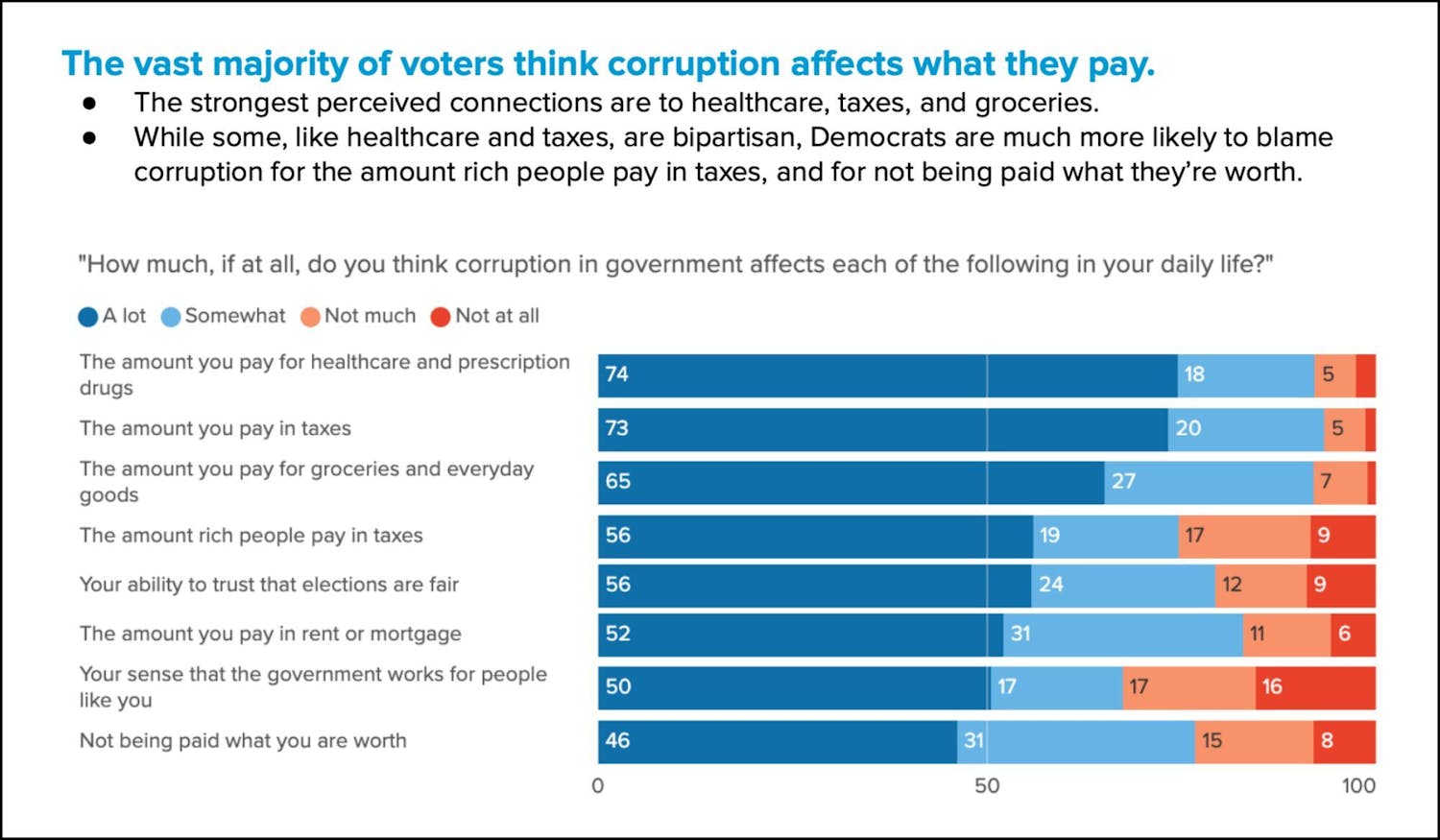
This is one of the clearest findings in the poll. Across every major cost category, voters consistently see corruption as part of the reason prices are high and why they are struggling in this economy.
Healthcare is where voters most clearly see the link between corruption and cost, and it is also where Democrats hold their largest trust advantage. Voters explicitly link high drug prices and lack of accountability to politicians’ financial ties to Big Pharma. As one voter from New Mexico explained: “Our government hasn’t done anything to bring down the ridiculously high cost of medications because many of our Reps make money off drug companies.”
VOTERS TRUST NEITHER PARTY ON CORRUPTION
Despite the salience of the issue, voters do not know which party to trust. While Democrats and Republicans each have clear trust advantages on some issues, 46% trust neither party on corruption, and 45% trust neither on bringing needed change to Washington. Among movable voters (those who do not have strong views of either Donald Trump or either party), only 11% trust Republicans, offering anti-corruption Democrats a huge opportunity to show voters that they will fight corruption in a way that other politicians have failed to do.
Voters are hungry for accountability and change, but they have not decided who can deliver it. This creates a wide-open lane for candidates.

VOTERS REWARD CANDIDATES WHO RUN AGAINST CORRUPTION
When voters are given a clear choice, candidates who focus on anti-corruption consistently outperform those who do not, especially when it’s tied to affordability.
When given a description of an anti-corruption Democratic candidate and a description of an affordability-focused Democrat, voters prefer the anti-corruption candidate by a 55-29 margin – and 56-21 among movable voters. Even among Democratic voters, only 62% say they would be likely to vote for a Democrat who believes that corruption is a problem but is focusing on kitchen table issues instead.
The most effective message does not treat corruption and affordability as separate. It explicitly links the two, arguing that cleaning up corruption is one of the best ways to lower costs and make the economy work for everyday Americans. That framing is highly persuasive, particularly among moveable voters.
The takeaway is unmistakable: Candidates who lead with anti-corruption are not just aligning with voter concerns, they are gaining a measurable electoral advantage, especially when they connect corruption to affordability.

THE MOST POPULAR ANTI-CORRUPTION REFORMS
Voters are aligned on what should be done to address the corruption problem in Washington. Across a wide range of reforms, support is overwhelming and bipartisan.
When voters are asked to prioritize, several measures consistently rise to the top. Banning members of Congress from trading stocks (90% strongly support), banning corporate PAC contributions (74% strongly support), and Supreme Court reform (63% strongly support) all rank among the most popular anti-corruption proposals.
This level of agreement is unusual in a polarized environment. Voters are not divided on the need for reform, and candidates do not need to guess what anti-corruption means to voters.

RECOMMENDATIONS
The data in this poll points to a clear strategic path for candidates in battleground districts.
First, make corruption central to the campaign. With 42% of voters ranking it as a top issue and nearly half trusting neither party to address it, this is the central driver of how voters are evaluating candidates.
Second, tie corruption directly to the cost of living, especially healthcare. Voters already make this connection, with 74% saying corruption has a major impact on healthcare costs and large majorities saying it affects what they pay for groceries and house. This is the most effective way to make the issue concrete and relevant.
Third, lead with specific, popular reforms. Policies like banning congressional stock trading and ending corporate PAC contributions are overwhelmingly popular, giving candidates a clear and credible agenda to run on.
Corruption is not competing with affordability. It is one of the clearest ways to talk about why costs are high, why families are getting economically squeezed, and why so many believe the system isn’t working for them.
At a time when voters are deeply cynical about Washington and increasingly convinced that wealthy donors, corporate interests, and insiders are rigging the system for themselves, candidates who center corruption, connect it to costs, and back it up with concrete reforms are best positioned to win in November.